

 English
 German
 Spanish
 Italian
 Japanese
 United states
Medical billing specialists, urologists, and radiologists will want to pay close attention to the latest prostate biopsy CPT code update that went into effect on January 1, 2026. This long-awaited update primarily affects billing for standard TRUS prostate biopsies and rewards the use of more sophisticated technology, including MRI-ultrasound fusion.
Are you looking to learn more about prostate biopsy CPT codes in 2026 and the changes set forth by the American Medical Association? Continue reading to find out changes which will affect CPT codes and reimbursement for prostate biopsies in 2026 and beyond.
2025 Prostate Biopsy CPT Codes
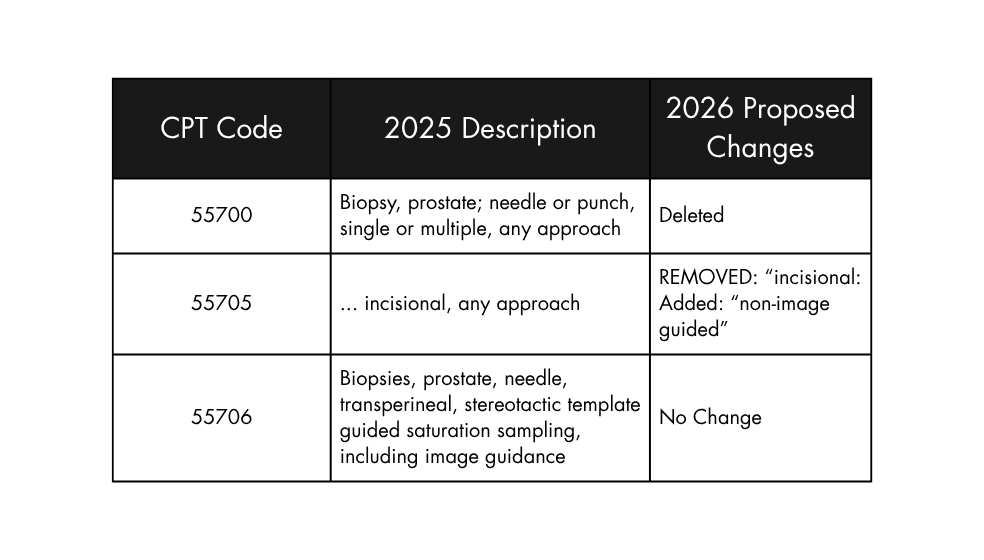
The following CPT codes were active in 2025 but have been affected by the prostate biopsy code changes in 2026. Specifically, CPT code 55700 will be deleted, CPT code 55705 indicates non-image guided biopsy, and CPT code 55706 remains unchanged, as shown in the table below:
2026 TRUS Biopsy CPT Codes
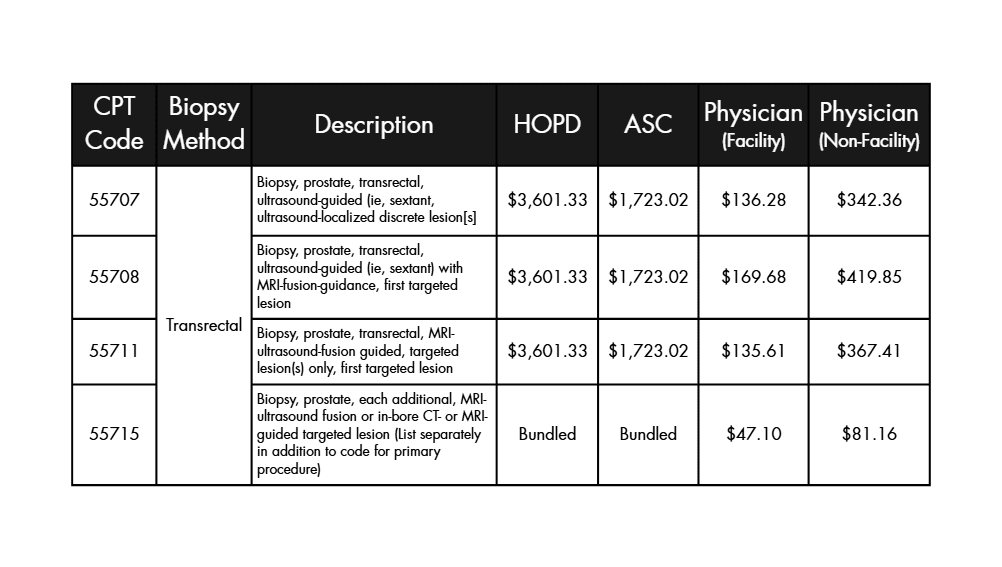
The new year is set to bring a significant overhaul to the coding for TRUS prostate biopsies— specifically CPT code 55700. This change is designed to better differentiate and accurately report the diverse methods now employed in prostate biopsies using ultrasound guidance (CPT code 76872).
The new codes create separate billing for the traditional TRUS guided prostate biopsy (both with and without MRI-fusion) and the more advanced, targeted lesion biopsies utilizing MRI-ultrasound fusion guidance. This segmentation reflects the increasing adoption of advanced imaging and fusion technology in urology practices.
The table below outlines the code changes related to TRUS prostate biopsies in 2026:
2026 Transperineal Biopsy CPT Codes
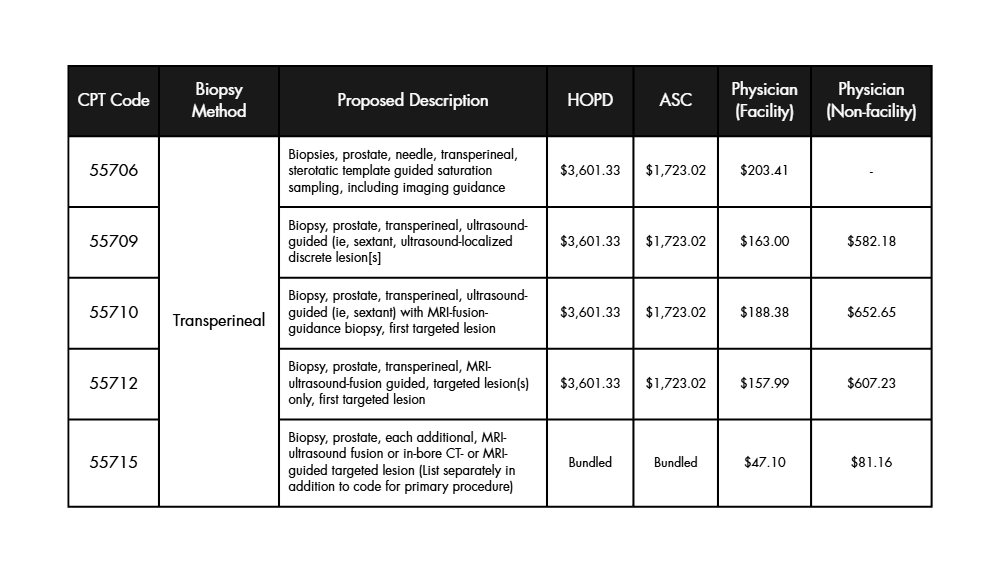
In line with changes to the TRUS biopsy approach, the 2026 CPT code structure for transperineal (TP) prostate biopsies is also shifting to a more detailed system, with changes to CPT code 55706.
The new codes, summarized below, specifically differentiate between the traditional sextant method and the advanced targeted biopsy of specific lesions, with a separate designation for utilizing MRI-fusion guidance. This change may also have an effect on billing for prostate MRIs, particularly prostate MRI CPT code 72197, 72196, and 72197¹.
Final Thoughts
In short, the prostate biopsy CPT codes are experiencing a major overhaul in 2026. These changes will allow hospital systems and private practices to use sophisticated biopsy methods with higher reimbursement rates than in previous years.
The CPT code changes encourage physicians and hospital systems to use advanced biopsy systems as opposed to traditional approaches without MRI-ultrasound fusion technology, which provides a higher standard of care². While adoption of fusion biopsy technology represents an added capital investment for many practices, the improved reimbursement structure and diagnostic accuracy may justify the transition.
References
1 – Multiparametric MRI for the Evaluation of Prostate Cancer. CARL BRYCE, MD, FAAFP, AND AMANDA RAPP, MD, FAAFP, Abrazo Family Medicine Residency, Phoenix, Arizona. American Family Physician. June 2022. https://www.aafp.org/pubs/afp/issues/2022/0600/p665.html
2 – Marks L, Young S, Natarajan S. MRI-ultrasound fusion for guidance of targeted prostate biopsy. Curr Opin Urol. 2013 Jan;23(1):43-50. doi: 10.1097/MOU.0b013e32835ad3ee. PMID: 23138468; PMCID: PMC3581822. https://pmc.ncbi.nlm.nih.gov/articles/PMC3581822/