
 English
 German
 Spanish
 Italian
 Japanese
 United states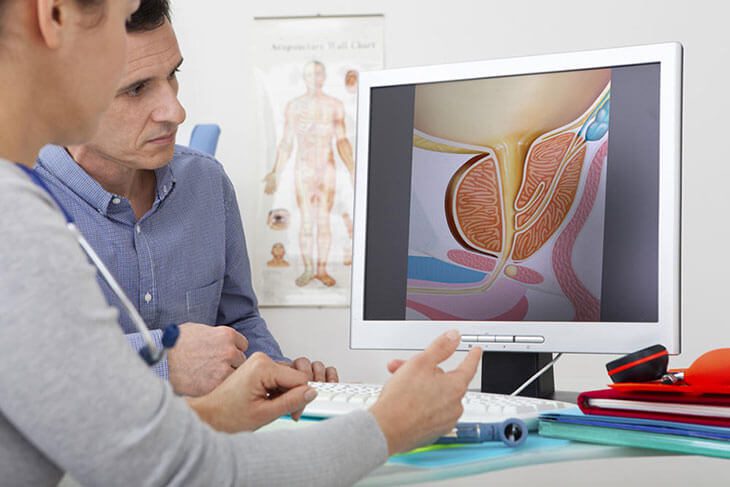
Prostate biopsies are an essential step for prostate cancer diagnosis. Today, there are two ways to perform them: by transreactal or transperineal route. Both approaches present benefits and limits, but international guidelines recommend performing transperineal prostate biopsy. Why? Because this way consists of passing the biopsy needle through the perineal skin rather than passing through a potentially contaminated rectum. But, this is not the only argument.
In this article, we will explore all aspects of transperineal biopsy from history to benefits of the route, thanks to significant inputs from urologists and concrete examples.
The emergence of transperineal route
Before 2019, prostate biopsies were mainly performed by the transrectal route. The transperineal route was not used because it is supposed to be painful. But, in the 50s, both routes were used, until the 2000s when fusion biopsy came up. The question was not which route to use anymore, but how to set up software fusion. So, everyone used transrectal approach because it was easier and less painful at this time.
But this approach has shown a high infectious complications rate. Several options were available to avoid this elevated risk of infection:
- Use of rectal swab and use of antibioprophylaxis
- Use of the rectal route with povidone iodine
- Use of Transperineal route to avoid the rectum
Some physician have chosen to use transperineal route because the infection rate was lower (less than 1%). First, they began to do prostate biopsies under general anesthesia, but there were some limitations because it was COVID time so the access to the operating room was complicated, it took more time than transrectal route… So another alternative was to perform the biopsies under local anesthesia. And this technique has been successful!
Several teams from different hospitals have confirmed that performing transperineal prostate biopsies under local anesthesia is safe and feasible! Several studies have shown that infection rate is less than 1% for 5 to 7% for transrectal route. Another argument to switch from transrectal to transperineal route. To strengthen these experiences, European guidelines recommend to use transperineal approach under local anesthesia since 2021. It is a strong recommendation that opens a new field of prostate cancer diagnosis.
Transrectal prostate biopsy: why using this route?
As we said ealier, physicians use to perform transrectal biopsies in their daily practice. It is easy and seems to be pain free for the patient. So, it is not easy to change the practice in one day, it takes time. To make things change, we need to bring the evidence that it works, and it is safe. This first step is now completed with a lot of studies, trials, but also the strong recommendations from international authorities.
But now, the main barrier is the device. Medical device is expensive, so if physicians don’t have a system that allows performing both transperineal and transrectal route, they will have to change it and that takes time and money. There also is a need of training the team and show that it is not more difficult than transrectal approach. For example, at Hôpital Cochin, in Paris, student learn transperineal biopsies, they don’t do transrectal route at all.
Then, now that evidence is proved, we need to spread the message about transperineal biopsy, and that takes time also. Things are moving and we will see the results in the next few years.
“It takes time to change the practice. We have to realize that the technique is new. European guidelines changed only two years ago. It's yesterday.”
Julien Anract, Hôpital Cochin (France)
Transperineal approach: concrete benefits
Of course, the first benefit of transperineal biopsy is the low rate of infection (less than 1%). Studies have shown the evidence of decreasing infection rate without using any antibiotics. This is the real benefit, because if physicians use transrectal route, they have to use antibiotics. But in 2021, EAU guidelines have banished fluoroquinolone even for transrectal route because studies have shown that there is a high resistance (15% in France in 2022). If there is resistance, there is the use of more antibiotics. This is why the switch to transperineal route without any antibiotics is recommended since 2023 by EAU guidelines.
The other reason to switch from transrectal to transperineal route is to have an unique route from diagnosis to treatment. With the emergence of focal therapy needle-guided, more doctors show interest to this approach because the route shows less infection and we want to avoid rectal injuries. Indeed, focal therapies are rising, and one day or another it will be a standard of care for selected patient, so physicians have to be ready to perform it. Looking at this picture, the all prostate care journey should use the same technique.
To finish, recent data have shown that transperineal prostate biopsies is better than transrectal route for the detection rate.
“And whatever the energy, focal therapy will be performed by Transpareineal route because we have to avoid infection. So looking at this picture, biopsy should be done using the same route. And I can go further, it must be done with the exact same technique, the same device and the same surgeon. It's easier, it's safer and it's reproducible, so there is no question in that.”
Julien Anract, Hôpital Cochin (France)
Sources :
- Podcast de Dr Julien Anract (https://podcast.ausha.co/prostate-talk)
- EAU guidelines : https://uroweb.org/guidelines/prostate-cancer
- “Refining the risk stratification of transrectal biopsy detected prostate cancer by elastic fusion registration transperineal biopsies” Bajeot et al, World J Urol, September 2021
- “Accuracy of elastic fusion biopsy in daily practice: results of a multicenter study of 2 115 patients” Orderda et al, Int J Urol, August 2018