

 English
 German
 Spanish
 Italian
 Japanese
 United states
One of the most common causes of urinary tract issues in aging men is an enlarged prostate, medically known as benign prostatic hyperplasia (BPH). The prevalence of enlarged prostate has been shown to increase in advancing age, and studies show up to 90 percent of men at autopsy showed signs of enlarged prostate¹.
While there are several ways men can mitigate their risk of developing an enlarged prostate, some risk factors, like genetic predisposition, are out of their control. Luckily, with advanced treatment options and innovations, the latest treatments for enlarged prostate provide men with confidence that their condition can be safely treated if developed.
This article discusses the latest treatment for enlarged prostate, along with conventional treatment methods and data-backed research so you can gain a full understanding of enlarged prostate issues and treatment options.
“New treatments such as prostate artery embolization and Optilume BPH Catheter System have emerged as promising treatments for enlarged prostate today.”
What is Enlarged Prostate? (BPH)
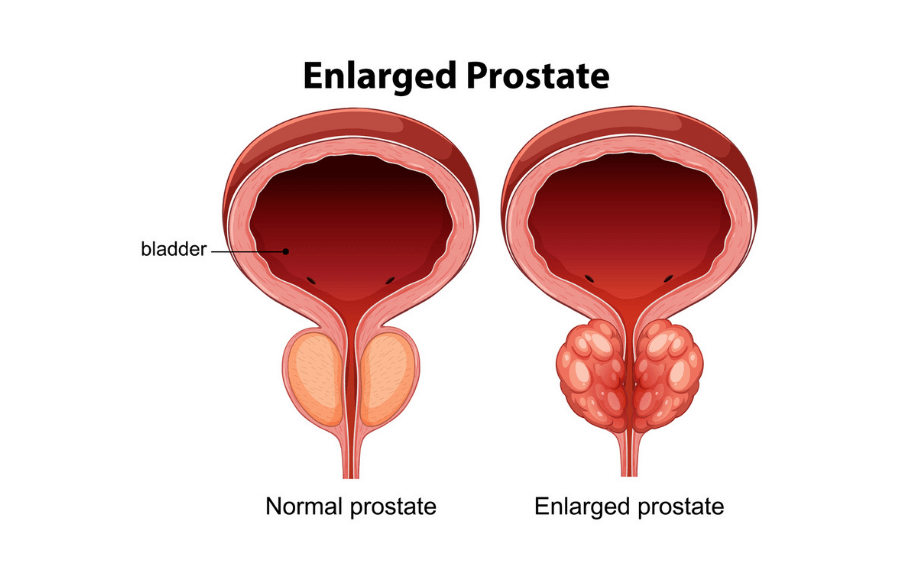
Changes in hormone levels, age, and cellular development are believed to be the main causes of enlarged prostate, although the exact cause remains unknown. An enlarged prostate can partially block part of the urethra and cause lower urinary tract symptoms that can be painful and stressful for men.
Additional symptoms of enlarged prostate include frequent urination, urgency, weak urine stream, dribbling after urinating, difficulty starting urination, and feeling that the bladder hasn’t fully emptied. These symptoms vary between men with BPH and can range from mild to severe.
Several risk factors increase the odds of developing an enlarged prostate, including diabetes, obesity, metabolic syndrome, genetic predisposition, diet, and more. Avoiding the worst foods for prostate health is one of the main ways aging men can reduce the likelihood of BPH and other prostate issues later in life.
Latest Treatment for Enlarged Prostate

Treatment options for enlarged prostate come in many different forms. While conventional methods remain effective, several new treatment options and breakthrough technologies are now able to resolve enlarged prostate symptoms faster than other methods.
Prostate Artery Embolization (PAE)
Prostate artery embolization is a minimally invasive and non-surgical treatment for enlarged prostate that uses X-rays to guide the delivery of prostate artery embolization (PAE) directly to the prostate². This procedure prohibits blood flow to the prostate gland and causes it to shrink in size.
Men who have had prostate cancer screening or have persistent urinary issues may be candidates for prostate artery embolization. The procedure requires a catheter to be inserted through the wrist and guided to the prostate, then X-ray beads are sent to the gland and restrict blood flow. Sedation is mild, and many patients return home the same day after monitoring.
Cedars-Sinai interventional radiologist H. Gabriel Lipshutz, MD notes that patients undergoing PAE are very happy with the results and can’t believe how quickly their lives have changed when symptoms subsided. Some patients had extreme symptoms, such as the total inability to urinate, and suffering was alleviated after the procedure.
“Patients undergoing prostate artery embolization saw extreme symptoms, such as the total inability to urinate, subside after the procedure, which drastically improved quality of life.”
Optilume BPH Catheter System
Another minimally invasive enlarged prostate treatment option uses double-lobe balloon technology to reduce pressure on the urethra to improve urinary flow rates³. Approved by the FDA in 2023, the Optilume BPH Catheter System provides immediate and sustained improvements in mild to severe symptoms of enlarged prostate⁴.
In fact, a 2023 study showed that, among 148 men at 18 centers in the United States and Canada, subjects saw a significant reduction in prostate symptom scores after one year post-treatment along with an improved flow rate compared to the previous year.
Conventional Treatment for BPH

While new, innovative treatments for enlarged prostate remain in development and more research is needed, conventional treatments are still widely used for their proven effectiveness. Medications treating BPH are common for mild to moderate symptoms, and include alpha blockers like Uroxatral and Flomax as well 5-alpha reductase inhibitors⁵.
Additionally, other minimally invasive surgeries are effective as well. The UroLift system involves permanent implants that lift and hold the enlarged prostate tissue away from the urethra and offer a quick recovery while preserving sexual function.
Final Thoughts
While the latest treatment for enlarged prostate involves a mix of innovative procedures and conventional ones, it’s still true that an enlarged prostate is a very treatable condition that affects millions of men each year.
Innovative treatments like prostate artery embolization (PAE) and the BPH Catheter System are revolutionizing the way doctors treat enlarged prostate, and traditional medicine and proven procedure methods remain a viable and cost effective way to alleviate symptoms.
References
1 – Ng M, Leslie SW, Baradhi KM. Benign Prostatic Hyperplasia. [Updated 2024 Oct 20]. In: StatPearls [Internet]. Treasure Island (FL): StatPearls Publishing; 2025 Jan-. Available from: https://www.ncbi.nlm.nih.gov/books/NBK558920/
2 – ‘Life-Changing’ New Treatment for Enlarged Prostate. Cedars-Sinai. 2024. https://www.cedars-sinai.org/newsroom/a-life-changing-treatment-for-enlarged-prostate/
3 – FDA approves new surgical treatment for enlarged prostates. Harvard Health. 2023. https://www.health.harvard.edu/blog/fda-approves-new-surgical-treatment-for-enlarged-prostates-202310252985
4 – Kaplan SA, Moss J, Freedman S, Coutinho K, Wu N, Efros M, et al. The PINNACLE Study: A Double-blind, Randomized, Sham-controlled Study Evaluating the Optilume BPH Catheter System for the Treatment of Lower Urinary Tract Symptoms Secondary to Benign Prostatic Hyperplasia. Journal of Urology [Internet]. 2023 Sep 1 [cited 2025 Aug 8];210(3):500–9. Available from: https://doi.org/10.1097/JU.0000000000003568
5 – Benign prostatic hyperplasia (BPH). Mayo Clinic. https://www.mayoclinic.org/diseases-conditions/benign-prostatic-hyperplasia/diagnosis-treatment/drc-20370093