

 English
 German
 Spanish
 Italian
 Japanese
 United states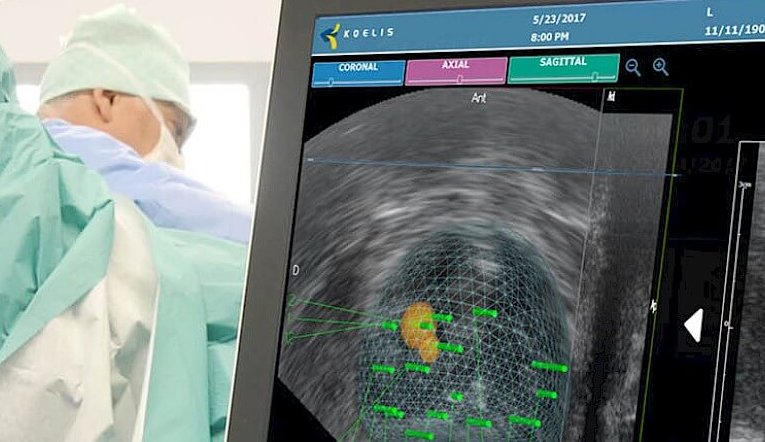
Above: Prostate ultrasound as viewed on KOELIS Trinity® with lesions and targets marked.
A prostate ultrasound is typically used during a prostate biopsy, which is a procedure that screens for the presence of cancer in the prostate. While prostate cancer is one of the most common types of cancer among men in the United States, prostate biopsies with 3D ultrasound guidance make pinpointing and treating cancerous lesions more effective than ever before.
Are you looking to learn more about prostate ultrasound and prostate biopsy? This article discusses the prostate biopsy procedure using prostate ultrasound, its risks, and methods for targeting prostate cancer.
What is a Prostate Ultrasound?
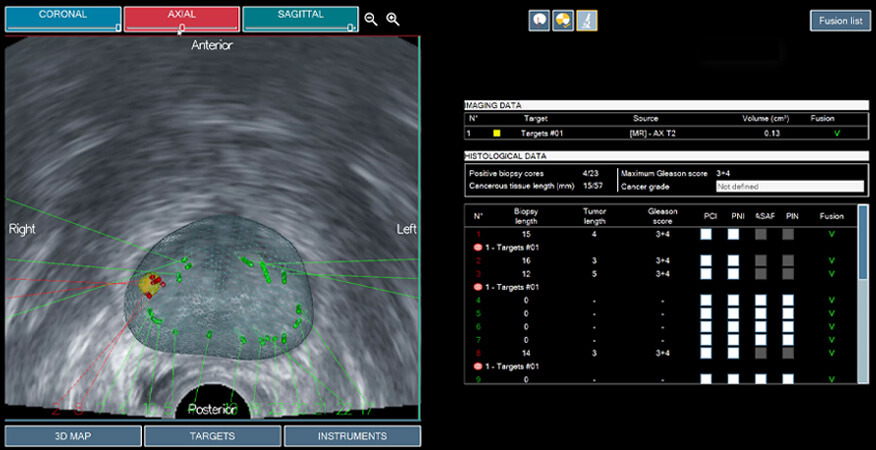
A prostate ultrasound, called a transrectal ultrasound (TRUS), is a medical imaging test used to visualize the prostate and its surrounding structures in real time with ultrasound imaging technology. Ultrasounds use high-frequency sound waves to produce live images of internal organs, such as the prostate.
For a prostate ultrasound during a biopsy, a small probe with a transducer is inserted into the rectum. This positioning allows the probe to sit close to the prostate for clear imaging. Using the KOELIS Trinity® MRI-ultrasound fusion system, physicians create a 3D mapping of the prostate to plan out lesion targeting during biopsy and perform the procedure transrectally or transperineally.
Prostate ultrasounds are performed for a variety of reasons, but they are typically ordered to evaluate prostate size (in the case of BPH or enlarged prostate), to guide a prostate biopsy procedure, to assess abnormalities such as nodules and cysts, as well as to measure prostate volume to plan subsequent treatments.
“While prostate cancer is one of the most common types of cancer, prostate biopsies with 3D ultrasound guidance make pinpointing and treating cancerous lesions more effective than ever before.”
Prostate Ultrasound Procedure
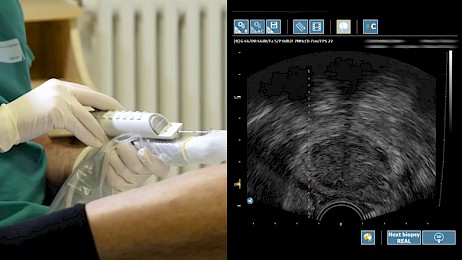
Before a prostate ultrasound, preparation and planning is required. Patients are not typically required to fast, but some physicians ask for a mild enema a few hours before to clear the rectum for better imaging and comfort. Patients may also be asked to stop blood thinner medication temporarily to reduce bleeding risk.
In a transrectal ultrasound, the patient lies on their left side (the left lateral decubitus position) and a thin lubricated ultrasound probe is gently inserted into the rectum. The transducer at the end of the ultrasound probe emits sound waves and captures the returning echoes that produce ultrasound images on a monitor. The physician moves the probe slightly to obtain different angles and images of the prostate to assess overall size and volume as well as the presence of nodules or cysts.
If a prostate biopsy is required, the physician uses a biopsy needle with a guide to take samples from targeted areas of the prostate gland suspected of containing cancer. Using KOELIS Trinity’s Organ-Based Tracking® (OBT) technology, the system tracks the prostate gland and compensates for patient movement and prostate deformation for a highly accurate view of the prostate for targeting.
Transrectal Ultrasound Guided Prostate Biopsy
One of the primary reasons physicians use a prostate ultrasound is to perform prostate biopsies. However, not all urologists use high-quality imaging technology, which can affect the biopsy results. Let’s talk more about TRUS prostate biopsy.
The transrectal ultrasound guided prostate biopsy can be performed via the transperineal or transrectal route. Systems like KOELIS Trinity favor the transperineal route because of lower risk of infection¹ and its ability to provide better access to all prostate zones with advanced imaging. The transperineal route requires the biopsy needle to enter via the perineum, while a transrectal biopsy has samples taken through the rectum.
After samples are taken (typically 12 cores), the physician sends them to pathology for analysis to determine the presence of cancer. The patient will schedule a follow up appointment to review the results with their doctor in the coming weeks. The prostate biopsy procedure is typically quick, and patients are able to resume normal daily activities within a few days.
“Systems like KOELIS Trinity® favor the transperineal route because of lower risk of infection and its ability to provide better access to all prostate zones.”
Prostate Ultrasound CPT Code

A CPT code (short for Current Procedural Terminology code) is a five digit code that’s used in healthcare settings to identify and bill for medical services. These codes are what drives physician reimbursement and are essential for documentation and communication purposes among healthcare providers and insurers.
The current CPT code for a prostate ultrasound is 76872, and is defined as the medical procedural code under the range of Diagnostic Ultrasound Procedures of the Genitalia². However, it’s important to understand that a prostate biopsy using ultrasound is listed under CPT code 55700 and 55706 and, when under ultrasound guidance, CPT code 76942 is used as well³. Also note that multiple CPT codes can be billed for a single procedure when applicable.
The Bottom Line
A prostate ultrasound is highly effective in a variety of procedures performed to diagnose prostate issues. The most common uses of a prostate ultrasound are during a prostate biopsy with ultrasound guidance along with imaging of the prostate for prostate volume and irregularities.
It’s important to note that not all ultrasound systems are created equal. The KOELIS Trinity system provides high-quality ultrasound and is the go-to biopsy platform for physicians screening patients for prostate cancer.
Ask your urologist about KOELIS, or find a certified provider in our network with our KOELIS Locator.
References
1 – Stangl-Kremser J, Ramaswamy A, Hu JC. Transperineal vs. transrectal biopsy to reduce postinterventional sepsis. Curr Opin Urol. 2023 May 1;33(3):193-199. doi: 10.1097/MOU.0000000000001083. Epub 2023 Mar 2. PMID: 36861767.
2 – CPT® 76872, Under Diagnostic Ultrasound Procedures of the Genitalia. Codify by AAPC. https://www.aapc.com/codes/cpt-codes/76872?srsltid=AfmBOoqpaQUBNZyivsBQM4ji1_9Si7JSW6KrW8t3Jj0ATOfQJQA_6H7F
3 – CPT® 55706, Under Incision Procedures on the Prostate. Codify by AAPC. https://www.aapc.com/codes/cpt-codes/55706?srsltid=AfmBOooiMZrlyvtMnZM7d6deB5KHG8-WzwUmmM3_it8_XxM-fWkK5plB