

 English
 German
 Spanish
 Italian
 Japanese
 United states
Fusion Prostate Biopsy with MRI-Ultrasound Guidance
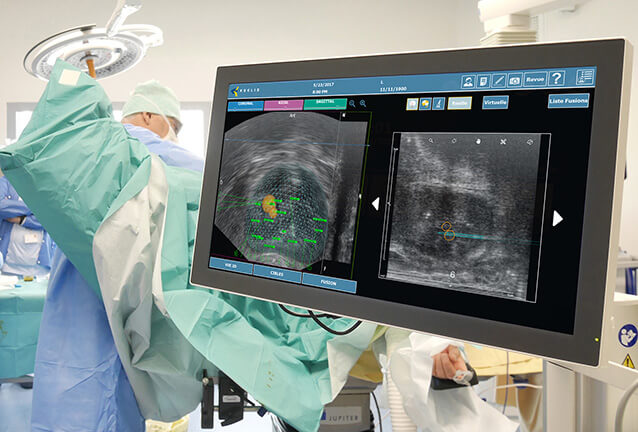
MRI/ultrasound fusion technology is the most accurate and efficient way to biopsy suspicious areas of the prostate. Our advanced technology helps physicians minimize overtreatment of non-aggressive cancers while also giving them confidence in AI-powered prostate contouring and lesion detection. The KOELIS Trinity® also provides real-time 3D MRI/ultrasound fusion and is proven to improve cancer detection rates and prostate biopsy accuracy.
Our fusion biopsy system employs advanced Organ-Based Tracking Fusion® (OBT) technology that tracks the prostate, not the probe. Our OBT technology automatically compensates for patient and prostate movement with no need to pause procedures for readjustment. The result of a Trinity biopsy is exceptionally accurate targeting as precise as 2.5 mm1.
Are you interested in KOELIS? Contact our team to learn more.
Achieve Maximum Accuracy with Elastic Fusion vs. Rigid Fusion
KOELIS Trinity® is the most advanced MRI/ultrasound fusion system for targeted prostate biopsy. Conventional MRI/ultrasound fusion systems use rigid fusion technologies that may display a distorted view of the prostate. Our elastic fusion platform overlays the MRI and ultrasound images and fuses them together for a real-time, accurate image of the gland that compensates for patient movement and prostate deformation.
Advantages of KOELIS Trinity:
KOELIS Patented Organ-Based Tracking®:
- AI technology automatically compensates for prostate and patient movement.
- There’s no need for tracking sensors, or for users to manually realign MRI or ultrasound images.
- With each biopsy needle pass, an updated 3D ultrasound is obtained to improve accuracy.
- Exceptionally accurate fusion biopsy, as precise as 2.5 mm1.
Our Competitors
- Simply track the ultrasound probe and require electromagnetic or mechanical sensors for accuracy
- Do not account for changes in prostate shape, leading to incorrect image registration and needle targeting
- Require constant manual re-alignment of ultrasound and MRI images throughout the procedure
KOELIS Probe Tracking
Want to learn more? Contact us for pricing & information.
Drawbacks of Existing Diagnostic Methods
Conventional 2D ultrasound biopsy sampling for prostate cancer detection is also known as random sampling and has several limitations, including:
- The biopsy may miss the cancer
- The biopsy under samples a clinically significant tumor, causing an underestimation of the patient’s risk group
- The biopsy oversamples a non-clinically significant tumor, which may lead to overestimating the cancer stage and overtreatment
KOELIS Trinity for Focal Therapy
Our versatile system can also be used to support targeted focal therapies such as:
- High-intensity focused ultrasound (HIFU)
- Cryotherapy
- Irreversible electroporation (IRE)
- Hydrogel Rectal Spacer
With the KOELIS Trinity system, urologists and hospitals have the ability to add specialty ultrasound probes to support additional prostate procedures. For instance, our abdominal and small parts probes can be used in the office or surgery center for testicular, kidney, and bladder scans.
Contact Us to Learn More
References:
1 Mean precision was 2.5 mm (95% confidence interval: 1.8 mm, 3.3 mm). Positive cores were closer to the center than were negative cores (dCC: 1.7 mm vs 3.1 mm, respectively; P = .025) https://pubmed.ncbi.nlm.nih.gov/29361246/ Precision Matters in MR Imaging-targeted Prostate Biopsies: Evidence from a Prospective Study of Cognitive and Elastic Fusion Registration Transrectal Biopsies François Cornud , Mathieu Roumiguié, Nicolas Barry de Longchamps , Guillaume Ploussard , Eric Bruguière , Daniel Portalez, Bernard Malavaud