

 English
 German
 Spanish
 Italian
 Japanese
 United states
Violette Clinical Trial

Thanks to advanced detection techniques, early diagnosis of prostate cancer is now more common, enabling the identification of small-volume, less aggressive tumors. The Violette multicenter study, led by Koelis, explores an innovative alternative to treat localized tumors using microwave needles guided by 3D image fusion. With 76 patients enrolled, this study aims to evaluate the efficacy and safety of this focal approach while minimizing its impact on patients’ quality of life. Discover the promising results of this technique.
Study Presentation
Today, although several therapeutic alternatives exist, the management of intermediate-risk prostate cancer remains a subject of debate. Indeed, due to their important impact on quality of life, radical treatments, such as surgery or external radiotherapy, are not suitable for these patients. Radical prostatectomy is correlated to urinary (incontinence) and sexual issues, raising the question of the benefit-risk ratio for patients with less aggressive tumors.
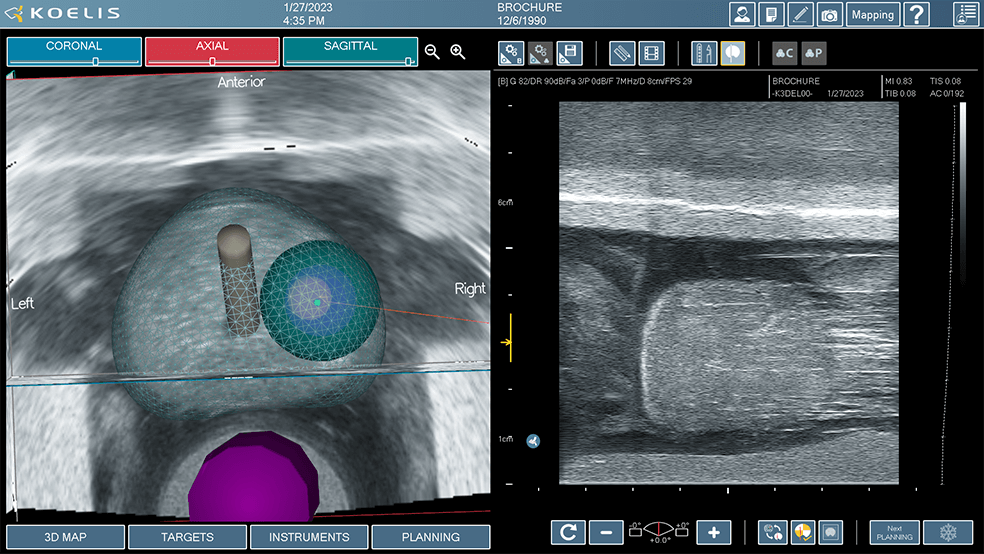
An innovative alternative is under investigation: targeting the most aggressive tumor, known as the “index tumor”, to reduce the risk of progression and avoid radical treatment. To perform such treatment, it is necessary to localize the tumor and to focus the therapeutic agent on the area which needs to be treated precisely.
Based on this assumption, KOELIS aims to combine tumor localization by MRI and targeted biopsies with image fusion to assess the efficacy of a targeted focal microwave treatment. As such, 76 patients with localized intermediate-risk prostate cancer have been enrolled and benefited from a TMA treatment in a European and multicenter trial, called VIOLETTE. Those patients have been followed for 12 months after the intervention.
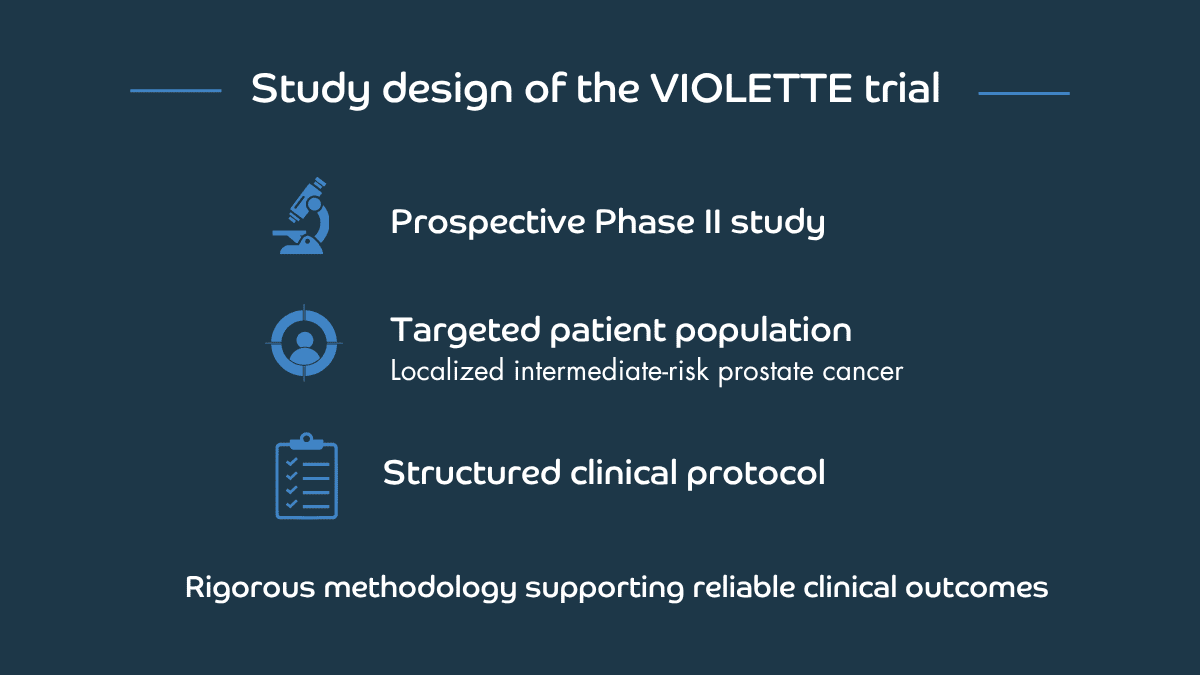
«Koelis demonstrates a strong commitment to clinical research, driven by rigorous scientific standards and ethical principles. The multicenter VIOLETTE study (NCT04582656) evaluated the efficacy of focal prostate cancer ablation using a microwave needle guided by advanced 3D image fusion technology. The final 12-month results have been published in BJU International and presented at the European Association of Urology congress. We were particularly pleased to see these findings recognized among the most impactful presentations of the meeting, highlighted in the “Take Home Messages” session » emphasizes Claire Jossan, Head of Clinical Research at KOELIS.
Study Results
Patients profile
Importantly, lesions were distributed across a wide range of prostate locations, including apex, mid-gland, base, and both peripheral and transitional zones. This reflects real-world clinical heterogeneity and highlights the ability of TMA, combined with MRI–ultrasound fusion and organ-based tracking, to precisely target tumors regardless of their anatomical position.
Oncological results
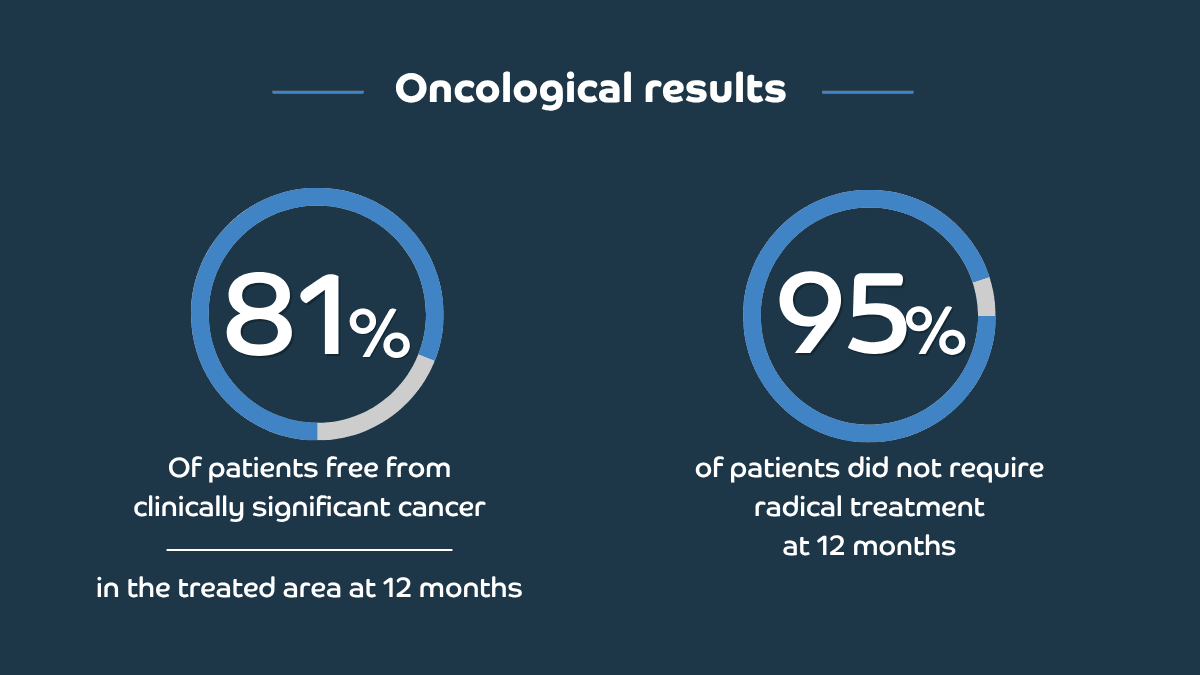
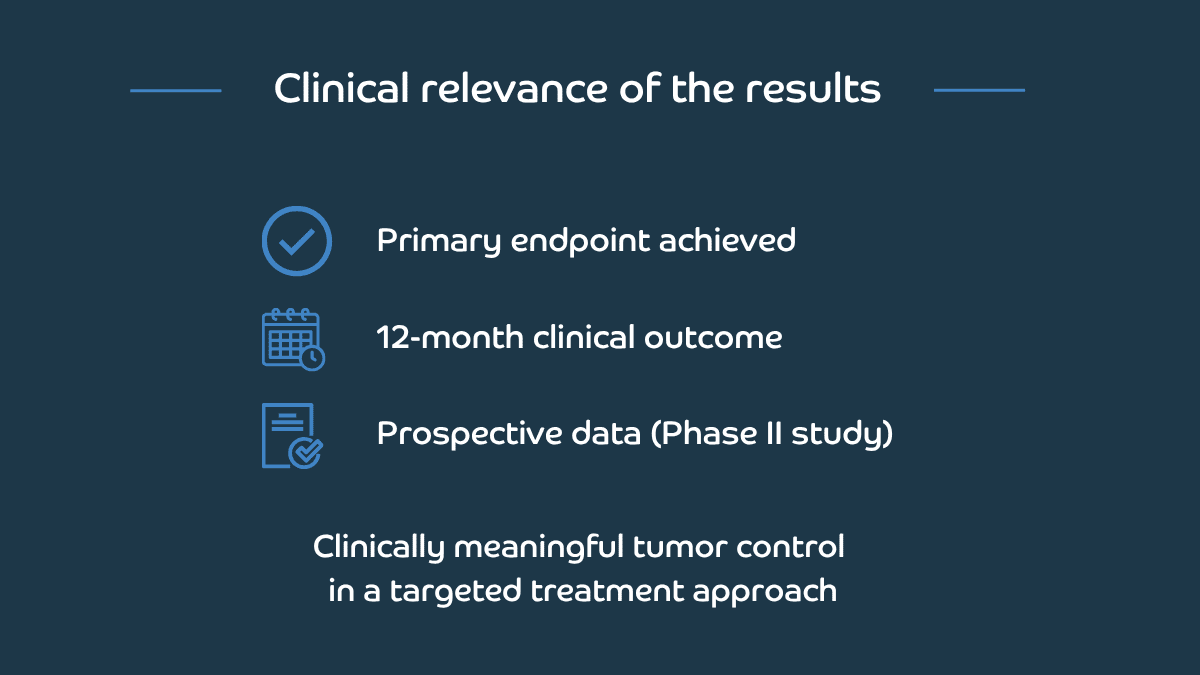
At 12 months, TMA achieved its primary endpoint, with 81% of patients free from clinically significant cancer within the treated area. 95% of patients did not require radical treatment, supporting the potential of TMA to defer or avoid more invasive therapies. A significant biological response was observed, with a 38% reduction in PSA levels.
Safety profile
The safety profile was favorable, with mostly low-grade, transient adverse events, and very few serious complications. Urinary function was preserved, while sexual function showed only a modest decline, consistent with the focal and tissue-sparing nature of the treatment.
TMA is a rapid and minimally invasive procedure, with a median duration of 51 minutes and typically performed in an outpatient setting. Postoperative pain was minimal, and recovery was fast, with most patients discharged without catheterization.
Conclusion
Targeted microwave ablation demonstrates a compelling combination of efficacy, safety, and preservation of quality of life. These promising results position TMA as an innovative focal therapy with the potential to transform the management of localized prostate cancer by offering effective tumor control with reduced treatment burden.
Violette publications
Barry Delongchamps N., et al. Targeted microwave ablation of localized prostate cancer: Initial results of VIOLETTE trial. BJU Compass 08/2024 > Link
Delongchamps NB, Peltier A, Potiron E, Bladou F, Diamand R, Messas A, Roche JB, Robert G, Hoepffner JL, Piechaud T, Anract J, Velthoven RV. Targeted microwave ablation of localized prostate cancer (VIOLETTE trial): a prospective multicenter study. BJU Int. 2026 Mar 11. doi: 10.1111/bju.70220. Epub ahead of print. PMID: 41810596. > Link
Bilbiography
Barry Delongchamps N et al – Feasibility and safety of targeted focal microwave ablation of the index tumor in patients with low to intermediate risk prostate cancer: Results of the FOSTINE trial. PLoS One. 2021 Jul > Link
Oderda M et al. Safety and Feasibility of Transperineal Targeted Microwave Ablation for Low- to Intermediate-risk Prostate Cancer. Eur Urol Open Sci. 2022 Oct 22. > Link
Chiu PK et al. Transperineal Targeted Microwave Ablation (TMA) of localized prostate cancer guided by MRI-Ultrasound fusion and organ-based tracking: a pilot study. Prostate Cancer Prostatic Dis. 2023 Dec. > Link
Chiu PK et al. Targeted Microwave Ablation (TMA) for prostate cancer under MRI-Ultrasound fusion and organ-based tracking: final results of the first phase 2 trial on efficacy. EU Oncology – 2024 Nov > Link
Oderda M., et al. Transperineal 3D fusion imaging-guided targeted microwaves ablation for low to intermediate-risk prostate cancer: results of a phase I-II study – MINIMALLY INVASIVE THERAPY & ALLIED TECHNOLOGIES Nov 2024 > Link
Peltier A et al. Targeted microwave ablation for prostate cancer (FOSTINE1b): a prospective ‘ablate-and-resect’ study. BJU Int. 2024 May 14. > Link