
 English
 German
 Spanish
 Italian
 Japanese
 United states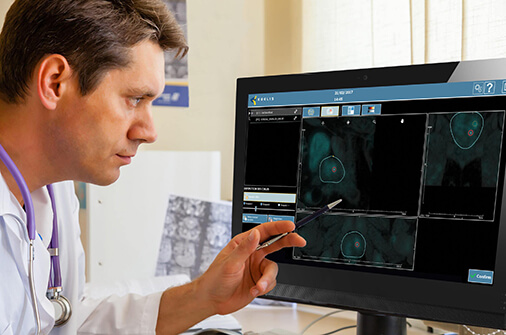
To raise awareness about men’s health and improve understanding of prostate cancer care, we’re focusing on how artificial intelligence contributes to the diagnosis of prostate cancer.
We had the opportunity to speak with Dr. Karsten Günzel from Berlin, Germany, about his daily practice and how he uses technology in prostate cancer management. Let’s take a closer look.
The Importance of MRI in Prostate Cancer Diagnosis
To best guide prostate biopsies, the fusion of MRI and ultrasound (US) images is a major advantage. For the most accurate targeting, MRI quality must be optimal — which isn’t always the case. This remains one of the main challenges for urologists.
That’s why strong collaboration with radiologists is essential to obtain a detailed and comprehensive report. Moreover, not all healthcare centers are equipped with highly advanced radiology units. This is where the urologist’s experience becomes critical — and where technological assistance proves invaluable.
Using AI to Analyze Imaging Data
MRI scans are treasure troves of information, making proper analysis crucial. Software tools play a key role in processing these large data volumes and assisting in the identification and localization of lesions.
While they don’t replace the expertise of radiologists, these tools help guide biopsies more accurately.
According to Dr. Günzel’s experience, AI-based software can confirm the radiologist’s report and even detect additional lesions that were previously unidentified — potentially allowing for more prostate cancers to be diagnosed.
The Impact of AI on Urologists’ Daily Practice
For urologists, AI helps confirm lesion locations, enabling them to perform biopsies with maximum precision and achieve the most reliable diagnosis possible. Dr. Günzel adds, “Artificial Intelligence is trendy right now, and patients respond positively when I tell them I use it.”
From a medical perspective, AI offers real comfort and confidence to urologists during biopsy procedures. More broadly, technology provides greater precision — which is essential not only for diagnosis but also for focal treatments. This is something clinicians can no longer overlook today.
Ultimately, with more reliable diagnostics, patients can benefit from personalized treatment options that significantly improve their quality of life.
Study Highlight: “Diagnostic Utility of Artificial Intelligence Assisted Transparency Biopsy Planning in Prostate Care Suspected Men”
A detailed MRI report is essential for planning a transperineal prostate biopsy. While approved computer-aided diagnostic (CAD) tools can assist urologists in this task, evidence of a clinically significant improvement in prostate cancer detection has been limited.
Therefore, this study aimed to document the diagnostic utility of combining the PI-RADS (Prostate Imaging Reporting and Data System) framework with CAD for biopsy planning, compared to CAD alone.
The CAD tool tested for transperineal biopsy planning improved prostate cancer detection but also increased the number of sampled lesions and false positives. This approach could support more personalized biopsy planning based on both urologist and patient preferences.
https://pubmed.ncbi.nlm.nih.gov/38688825/